
Home › Products & Test Kits › Basepaws vs Wisdom Panel Cat DNA Test 2026
Basepaws vs Wisdom Panel Cat DNA Test 2026: Which Is More Accurate?

📌 The 30-Second Vet Buying Answer (2026 Summary):
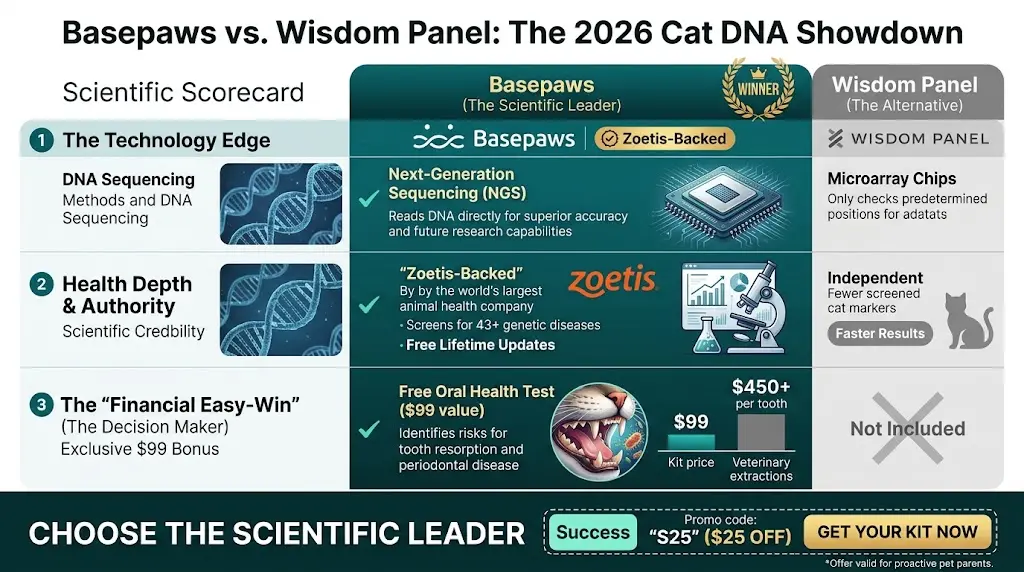
- Buy Basepaws ($129–$159) if you want the most accurate feline result. Basepaws was built for cats first, compares against 40+ recognized cat breeds + wildcat index, screens 40+ feline-specific disease groups (HCM, PKD, PRA, PKDef), tests 25 physical traits, offers an exclusive Dental Health Test, and updates your dashboard with new genetic findings for free forever.
- Wisdom Panel Cat ($99–$129) is a competent test built by a dog-dominated genetic company. While its laboratory call rate is accurate, its feline reference database is smaller (~25 breeds) and it lacks feline whole genome or oral microbiome upgrade paths.
- Vet Verdict: For purebred cat owners, mixed rescue cat parents, and proactive health planners, Basepaws is the undisputed #1 overall winner in 2026.
1. Basepaws vs Wisdom Panel: Side-by-Side Comparison Matrix
When cat owners compare DNA testing kits, shelf price is often misleading. The real value lies in the depth of feline reference data, the number of clinically actionable disease markers screened, and whether your results update as genetic research evolves.
| Comparing Feature | Basepaws (Cats First) | Wisdom Panel (Dogs First) | Veterinary Winner |
|---|---|---|---|
| Primary Scientific Focus | 100% feline-focused genetic research | Canine-focused platform with feline adaptation | Basepaws |
| Cat Breed Reference Library | 40+ recognized breeds + wildcat index (Asian Leopard Cat, Serval) | ~25 breeds & broad regional groups | Basepaws (Tighter breakdown) |
| Health Condition Screening | 40+ feline-specific disease groups (HCM, PKD, PRA, PKDef, SMA) | 45+ single gene conditions | Basepaws (Clinical grouping) |
| Blood Type Determination | Tests A, B, and AB/C blood group markers (Critical for emergency Rx) | Includes basic blood group markers | Tie |
| Physical Trait Markers | 25 coat, body, and facial traits (50+ genetic markers) | ~20 coat and body traits | Basepaws |
| Dental & Oral Health Screening | Yes — Exclusive Dental Health Test (swabs oral microbiome) | No dental or oral health screening available | Basepaws (Exclusive) |
| Lifetime Dashboard Updates | Yes — Free automatic updates as new feline science unlocks | Limited automatic report updates | Basepaws |
| Premium Upgrade Path | Whole Genome Sequencing (WGS – 100% DNA sequencing) | No feline Whole Genome option | Basepaws |
| Sample Collection Method | 15-second pain-free buccal cheek swab at home | 15-second pain-free buccal cheek swab at home | Tie |
| Prepaid Return Shipping | Yes — Prepaid US postage label included in box | Yes — Prepaid US postage label included in box | Tie |
| Turnaround Time | 4 to 6 weeks from lab receipt | 2 to 4 weeks from lab receipt | Wisdom Panel (Slightly faster) |
| Best Overall For | Rescue cats, mixed breeds, health planners & dental monitoring | Multi-pet households prioritizing a single login for dogs & cats | Basepaws |
2. Which Cat DNA Test Is More Accurate in Real Use?
When pet owners ask “Which test is more accurate?”, genetics experts evaluate accuracy across three distinct scientific dimensions:
A. Laboratory Genotyping Accuracy (99.9% Call Rate)
This measures how accurately the laboratory machines read the raw single nucleotide polymorphisms (SNPs) on your cat’s buccal swab. Both Basepaws and Wisdom Panel process samples in accredited, CLIA-grade genomics laboratories using custom Illumina array-based microchips. Both achieve a >99.9% technical call rate on clean, un-contaminated samples. In terms of raw lab reading, both kits are virtually equal.
B. Reference Library Accuracy (Where Basepaws Wins)
Raw SNP data is meaningless without a reference database. Your cat’s genetic code is compared against a reference library of known purebred cats. Because Wisdom Panel invests the vast majority of its research budget into its canine database (comprising hundreds of dog breeds), its feline reference library remains capped at around 25 breeds.
In contrast, Basepaws was founded specifically for feline genetics. Its reference library includes over 40 recognized domestic cat breeds and layers wildcat index data (such as Asian Leopard Cat and Serval) on top. For a shelter cat or domestic shorthair with mixed heritage, Basepaws’ larger reference library delivers a significantly more precise, granular breakdown rather than lumping results into broad regional buckets.
C. Actionable Clinical Health Accuracy
A DNA report is only as accurate as its ability to improve your cat’s health outcomes. Basepaws formats its health reports into 40+ disease groups with clear risk ratings (Low Risk, Carrier, High Risk) designed specifically for veterinary consultation. Furthermore, Basepaws includes a dedicated Feline Dental Health Test option—analyzing the oral microbiome to detect early periodontal disease and tooth resorption risks before visible lesions appear.
3. Genetic Health Screening: HCM, PKD, PRA & Blood Typing
Breed percentages make for fun social media posts, but genetic health screening saves lives. Cats are notoriously adept at hiding chronic illness until organ damage is advanced. DNA testing allows veterinarians to identify inherited mutations years before clinical symptoms manifest.
Key Conditions Screened by Basepaws:
- Hypertrophic Cardiomyopathy (HCM): The #1 diagnosed heart disease in cats, causing thickening of the heart muscle walls. Basepaws screens for key MYBPC3 gene mutations prevalent in Maine Coons, Ragdolls, and domestic shorthairs. Early detection enables early echocardiogram monitoring and preventative therapy.
- Polycystic Kidney Disease (PKD): An autosomal dominant mutation in the PKD1 gene that causes fluid-filled cysts to destroy kidney tissue. Highly prevalent in Persians, Exotic Shorthairs, and domestic crosses. Identifying PKD early allows owners to adjust hydration and kidney diets before renal failure occurs.
- Progressive Retinal Atrophy (PRA): Degenerative photoreceptor mutations (such as CEP290) that lead to gradual blindness in Abyssinians, Bengalis, and domestic cats.
- Pyruvate Kinase Deficiency (PKDef): An inherited hemolytic anemia resulting from an enzyme deficiency in red blood cells. Screened across Bengals, Somalis, and domestic shorthairs.
- Blood Type Determination (A, B, or AB/C): Crucial for breeding females (preventing Neonatal Isoerythrolysis) and ensuring safe blood donor matches during emergency veterinary care.
🩺 Clinical Telehealth Tip for Cat Owners:
If your Basepaws report indicates your cat is a carrier or at high risk for HCM, PKD, or renal sensitivity, do not panic. Connect with a licensed US online veterinarian via Dutch Pet Telehealth ($5/mo) to review your PDF report, discuss preventative ultrasounds, and optimize your cat’s renal hydration plan without an expensive clinic visit!
4. Price, Value, and Lifetime Cost Breakdown
Comparing initial sticker prices can be deceptive. To calculate the true 3-year value of a cat DNA kit, evaluate these four critical factors:
5. Basepaws vs Wisdom Panel: Which Cat DNA Test Should You Buy?
| Your Specific Household Situation | Our Recommended Winner | Why This Kit Is Better |
|---|---|---|
| Rescue or shelter cat with mystery heritage | Basepaws | Broader feline reference library (40+ breeds + wildcat index) gives a clearer, more granular breakdown. |
| Proactive health screening (HCM, PKD, PRA) | Basepaws | 40+ disease condition groups formatted into vet-ready clinical reports with carrier status. |
| Cat with bad breath, red gums, or dental risks | Basepaws Dental Test | Exclusive oral microbiome screen detecting early periodontal disease and tooth resorption risk. |
| Cat breeder or purebred line planning | Basepaws Whole Genome | Decodes 100% of the feline genome (2.7 billion base pairs) for comprehensive lineage tracking. |
| Household with multiple dogs and one cat | Wisdom Panel | Provides single dashboard convenience across a dog-dominated multi-pet household. |
6. What Smart Cat Parents Do the Week Results Arrive
Receiving your cat’s genetic report is just the beginning. To turn genetic data into long-term medical protection, follow these four clinical steps:
- Email the PDF Summary to Your Vet Clinic: Request that your veterinarian upload the genetic report to your cat’s permanent medical chart before your next annual exam.
- Schedule Early Diagnostic Screening for Red Flags: If your report flags HCM risk, schedule an early cardiac ultrasound (echocardiogram). If PKD risk is flagged, schedule a renal ultrasound and baseline SDMA bloodwork.
- Optimize Hydration & Renal Support: Cats with genetic kidney or urinary risks require maximum daily hydration. Upgrade to a circulating Petlibro Dockstream or Meowant Stainless Fountain to increase water intake by 50%+.
- Support Stress & Inflammation Naturally: For cats with chronic pain, inflammation, or dental sensitivity, integrate vet-formulated Bailey’s Feline Calm CBD Chews to support neuro-environmental comfort.
7. Frequently Asked Questions (FAQ)
Is Basepaws more accurate than Wisdom Panel for cats?
How long do Basepaws cat DNA test results take?
Can one DNA kit test two cats?
Will my veterinarian accept a Basepaws DNA report?
Is swabbing a nervous cat difficult?
Does Basepaws charge extra for future report updates?
What is the difference between Basepaws Breed & Health and Whole Genome Sequencing?
Does Wisdom Panel offer a feline dental or oral health test?
Affiliate Disclosure: One Health Globe participates in affiliate programs. When you buy through links marked rel=”sponsored noopener” on this page, we may earn a small commission at no extra cost to you. This enables our clinical veterinary team to keep our research guides 100% free. All recommendations are editorially independent and medically reviewed by Dr. Muhammad Usama, DVM (PVMC License #9472).