What this guide covers
- ✅ Complete grooming frequency schedule — daily, weekly, monthly by task
- ✅ Coat brushing by breed type — short, medium, long, and double-coated dogs
- ✅ Dental hygiene at home — the most overlooked but highest-impact habit
- ✅ Ear, eye, and paw cleaning — step-by-step routines
- ✅ Bathing frequency and product selection — including medicated shampoo guidance
- ✅ Bowl and bedding hygiene — CDC-backed cleaning standards
- ✅ Warning signs that need a vet — not just grooming fixes
Dog grooming at home does more than keep your dog looking clean. The ASPCA and AVMA both link regular grooming to earlier detection of lumps, skin infections, parasites, and dental disease — conditions that cost far more to treat when caught late. This guide gives you a practical, repeatable routine that takes under 20 minutes per day. For more dog health tools, visit our Pet Safety Hub and Pet Vaccine Tracker.
1. The Complete Dog Grooming Frequency Schedule
Most dog owners underestimate how often grooming tasks need to happen. The right frequency depends on your dog’s breed, coat type, activity level, and age — but the table below gives a solid baseline for all dogs.
| Task | Frequency | Why It Matters |
|---|---|---|
| Paw wipe after walks | Daily | Removes dirt, chemicals, heat, and allergens before licking occurs |
| Water bowl clean | Daily | CDC recommends daily cleaning — biofilm builds up within hours |
| Coat brushing (short coat) | Weekly | Removes loose fur, distributes oils, checks for lumps and parasites |
| Coat brushing (long/double coat) | Daily | Prevents matting, which causes skin sores and pain if untreated |
| Teeth brushing | Daily ideally / 3× min | AVMA gold standard — prevents periodontal disease in 80% of dogs by age 3 |
| Ear check and clean | Every 2–4 weeks | Prevents bacterial and yeast infections, especially in floppy-eared breeds |
| Eye wipe | 2–3× per week | Prevents tear staining, discharge buildup, and irritation |
| Full bath | Every 4–6 weeks | Over-bathing strips coat oils — medicated dogs may need more frequent bathing |
| Nail trim | Every 3–4 weeks | Overgrown nails cause gait problems and joint pain in senior dogs |
| Bedding wash | Weekly | CDC recommends weekly washing — reduces allergens, bacteria, and mite buildup |
| Food bowl wash | After every meal | Wet food residue grows bacteria within 30 minutes at room temperature |
| Toy cleaning | Monthly (or when dirty) | CDC guidance — rubber toys harbor mold, fabric toys harbor allergens |
Neakasa 5-in-1 Pro Dog Grooming Kit — Best for At-Home Grooming
The most-asked question from dog owners is: “What grooming tools do I actually need?” The Neakasa 5-in-1 Pro Kit covers everything in one package — deshedding brush, grooming comb, cleaning brush, and nail grinder, all powered by a quiet vacuum motor that captures loose fur directly. It’s the kit that replaces five separate purchases.
- ✅ 5 grooming heads in one unit — brush, comb, deshedder, nail, cleaner
- ✅ Built-in vacuum captures 99% of loose fur — no mess on floors
- ✅ Low-noise motor — less anxiety for sensitive dogs
- ✅ Delivered from US warehouse in 1–3 days
2. Coat Brushing — How to Do It Right by Breed Type
Brushing isn’t the same for every dog. The wrong brush for your dog’s coat type does more harm than no brushing at all — it can break the coat, miss matting, or irritate skin. Use this guide to find the right tool and technique for your dog.
Short-Coated Dogs (Labs, Beagles, Boxers, Dalmatians)
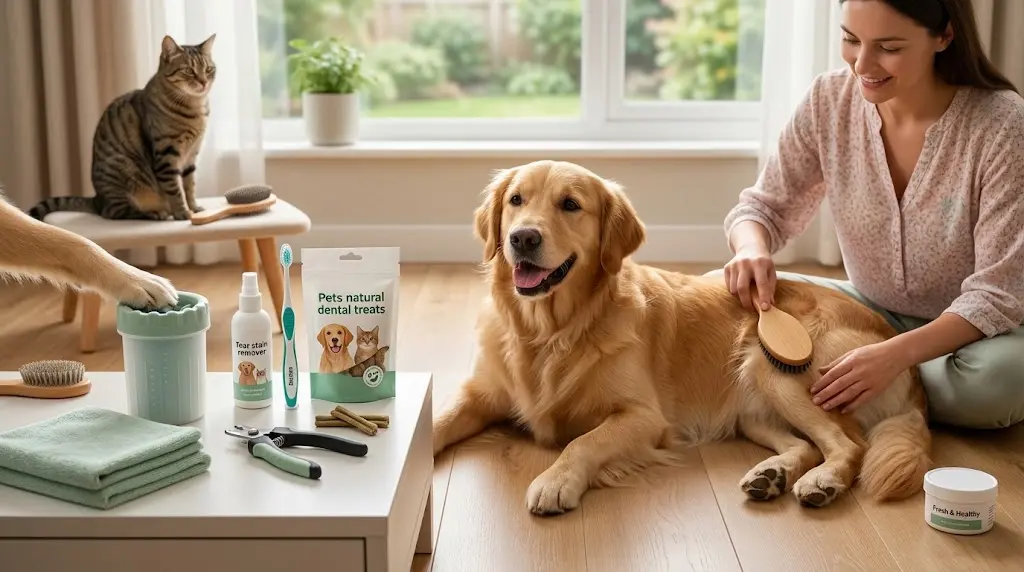
Use a rubber curry brush or bristle brush once or twice per week. These dogs shed steadily but don’t mat. Focus on direction of coat growth, using firm circular motions to loosen dead hair. A quick wipe with a damp cloth afterward removes the loosened fur without a full bath.
Medium-Coated Dogs (Golden Retrievers, Border Collies, Spaniels)
Brush 3–4 times per week with a slicker brush, followed by a metal comb to check for hidden mats near ears, armpits, and tail base. These dogs develop mats quickly during shedding season (spring and fall). Never cut a mat with scissors — use a mat splitter or seek a professional groomer.
Long and Double-Coated Dogs (Huskies, GSDs, Samoyeds, Pomeranians)
Daily brushing is non-negotiable. Use an undercoat rake first to remove dead undercoat, then a slicker brush for the topcoat, then a metal comb to check for mats. Never shave a double-coated dog — the double coat regulates body temperature in both heat and cold. Shaving causes permanent coat damage in many cases.
3. Dog Dental Hygiene — The Most Overlooked Health Habit
The AVMA reports that 80% of dogs show signs of periodontal disease by age 3. Dental disease doesn’t just cause bad breath — it leads to tooth loss, chronic pain, difficulty eating, and bacteria that can spread to the heart, kidneys, and liver. Yet most dog owners never brush their dog’s teeth.
The good news: a consistent home dental routine started early prevents most of this entirely. Here’s how to do it correctly.
Step-by-Step Dog Teeth Brushing Routine
- Choose the right toothpaste — enzymatic, pet-safe only. Never human toothpaste (xylitol is toxic to dogs).
- Let your dog lick the paste first — 2–3 days of this builds positive association before any brushing.
- Use a finger brush for the first week — easier to control and less intimidating than a full brush.
- Start with the front teeth — 30-second sessions only. Build gradually over 2 weeks.
- Work toward back molars — plaque builds fastest here. Use gentle circular motion at the gum line.
- Reward immediately after every session — this is the most important step for compliance.
Dutch Pet — Dog Dental Mint Toothpaste + Vet Dental Consult
If your dog’s breath is noticeably bad, has visible tartar buildup, or shows red gum lines — that’s not just a grooming issue, it’s a dental health emergency. Dutch connects you with a licensed US vet tonight who can assess your dog’s dental health, recommend a home care plan, and if needed, prescribe dental treatment delivered to your door.
- ✅ Vet-formulated dental toothpaste — mint flavor dogs accept more readily
- ✅ Licensed vet consultation same day — no waiting room
- ✅ Covers dental prescriptions, pain management, and follow-up care
- ✅ Consult your vet before starting any new dental treatment
4. Ear, Eye, and Paw Cleaning — The Weekly Essentials
Ear Cleaning
Healthy dog ears are light pink, odor-free, and produce minimal wax. Clean ears every 2–4 weeks using a vet-approved ear cleaning solution and a cotton ball — never a cotton swab inside the ear canal. Floppy-eared breeds (Basset Hounds, Cocker Spaniels, Beagles) need more frequent cleaning due to reduced airflow.
Eye Wiping
Wipe eye discharge gently with a damp cotton pad, always wiping outward from the inner corner. Breeds prone to tear staining (Maltese, Shih Tzu, Poodles) need daily wiping. Never use the same wipe for both eyes — this spreads bacteria between eyes. If discharge is yellow, green, thick, or accompanied by squinting, that’s a vet visit — not a grooming issue.
Paw Cleaning and Inspection
After every walk, wipe paws with a damp cloth and check between the toes for trapped grass seeds, debris, cuts, or redness. In summer, check pad temperature — heat-burned pads appear red, blistered, or missing patches of skin. In winter, rinse road salt thoroughly as it causes cracking and is toxic if licked in large amounts.
Dutch Pet — Dog Ear Drops & Ear Cleaning Solution
If your dog shows signs of an ear infection, at-home cleaning alone won’t resolve it. Dutch connects you with a licensed US vet who can prescribe the right medicated ear drops for your dog’s specific infection type — bacterial, yeast, or mixed — and have them delivered within 1–3 days.
5. Bathing Your Dog at Home — Frequency, Products, and Technique
Most dogs need a bath every 4–6 weeks. Dogs with skin allergies, heavy outdoor activity, or medicated shampoo prescriptions may need bathing every 1–2 weeks. Over-bathing a healthy dog strips the natural oils from the coat, leading to dry, itchy, flaky skin — the opposite of what you want.
Step-by-Step Home Bath Routine
- Brush first — always brush before bathing to remove mats. Wet mats tighten and become nearly impossible to remove.
- Use lukewarm water — test on your wrist first. Dog skin is more sensitive to heat than human skin.
- Dog-specific shampoo only — human shampoo disrupts the dog’s skin pH (6.2–7.4 vs human 5.5) and causes irritation.
- Work from neck to tail — avoid eyes and ear canals. Use a face cloth for the head.
- Rinse thoroughly — shampoo residue left on skin causes itching and dandruff. Rinse until the water runs clear.
- Dry immediately — damp fur causes hot spots and fungal growth. Towel dry vigorously, then use a low-heat dryer on a cool setting for thick-coated dogs.
Ruff Greens Skin Itching Relief Shampoo + Skin & Coat Supplement
If your dog scratches constantly after bathing, has flaky skin, or develops hot spots — the problem is often internal as much as external. The Ruff Greens Skin & Coat Booster addresses the root cause from the inside, while the Itching Relief Shampoo treats the surface. Use both for the fastest visible results.
- ✅ Shampoo formulated for sensitive, itchy, and allergy-prone skin
- ✅ Supplement sprinkles onto any existing food — no diet switch needed
- ✅ USA-made, vet-formulated, free JumpStart trial available
- ✅ Consult your vet if hot spots or hair loss are present
6. Bowl, Bedding, and Home Hygiene — CDC-Backed Standards
Dog hygiene isn’t just about the dog — it’s about the entire shared living environment. The CDC recommends specific cleaning standards for pet households to reduce zoonotic disease risk, especially in homes with children, elderly adults, or immunocompromised family members.
CDC-Recommended Cleaning Standards for Pet Homes
- Food bowls: Wash after every wet-food meal. Wash daily for dry food and water bowls.
- Water bowls: Rinse and refill twice daily minimum. Full wash with soap daily.
- Bedding and blankets: Wash weekly on hot cycle. More often if visibly soiled.
- Toys: Rubber toys monthly (dishwasher or bleach rinse). Fabric toys monthly in washing machine.
- Handwashing: After touching your pet, their food, bowls, toys, or waste — every time.
- Feeding areas: Keep completely separate from human food preparation zones.
Source: CDC Healthy Pets guidelines
7. Your Complete Dog Grooming Schedule at a Glance
Save or screenshot this — paste it on your fridge for the first month.
- Paw wipe after walks
- Fresh water + bowl rinse
- Food bowl washed after meals
- Brush (long/double coats)
- Teeth brushing (ideal)
- Eye wipe if discharge present
- Full coat brush (all breeds)
- Bedding and blankets washed
- Ear check (+ clean if needed)
- Eye wipe 2–3×
- Teeth brushing (minimum 3×)
- Quick home health check
- Full bath (4–6 week cycle)
- Nail trim
- Toy cleaning (rubber + fabric)
- Ear deep clean
- Check flea/tick prevention status
- Professional groom (long coats: 6–8 weeks)
- Vet dental check (annually minimum)
- Medicated shampoo bath (per vet Rx)
- Paw balm for cracked pads
Bailey’s CBD — No More Itch Chews + Skin Care Shampoo
If regular bathing and brushing haven’t stopped your dog’s scratching, the cause is likely internal — allergies, inflammation, or a compromised skin barrier. Bailey’s CBD No More Itch Chews are vet-formulated to address the inflammatory response driving the itch cycle, while the CBD Skin Shampoo soothes the surface simultaneously.
- ✅ Targets the inflammatory root cause — not just topical relief
- ✅ Results visible in 2–4 weeks of consistent use
- ✅ Third-party tested, USA-made, vet-formulated hemp supplement
- ✅ Consult your vet before use — especially for dogs on other medications
8. Warning Signs That Need a Vet — Not Just More Grooming
Regular grooming makes you the first person to notice when something is wrong. Don’t dismiss these signs as grooming problems — they often indicate underlying medical conditions that need diagnosis and treatment.
🚨 See a Vet — Not a Groomer — If You Notice:
- Hair loss in patches or circular bald spots (fungal infection or mange)
- Red, hot, weeping hot spots that grow despite treatment
- Strong odor from ears, skin, or mouth that doesn’t improve with cleaning
- Yellow or green eye or ear discharge
- Cracked, bleeding, or missing patches of paw pad skin
- Visibly inflamed, red, or bleeding gums
- Lumps, bumps, or swellings discovered during brushing
- Excessive scratching that continues despite bathing and brushing
For same-day vet access without a waiting room, Dutch Pet connects you with a licensed US vet tonight — they can assess symptoms, recommend next steps, and prescribe medicated shampoo, ear drops, skin treatment, or dental care if needed. Also see our Pet First Aid Checklist for at-home triage guidance.
Frequently Asked Questions
How often should I bathe my dog?
Most dogs need a bath every 4–6 weeks. Dogs with skin conditions, allergies, or heavy outdoor activity may need bathing every 1–2 weeks using a vet-recommended medicated shampoo. Over-bathing strips natural coat oils and worsens dry, itchy skin. Always use dog-specific shampoo — never human shampoo.
How do I brush my dog’s teeth at home?
Use a soft dog toothbrush or finger brush with pet-safe enzymatic toothpaste only. Never use human toothpaste — xylitol is toxic to dogs. Start with 30-second sessions, letting your dog lick the paste first. Build up to 2-minute sessions 3–5 times per week. The AVMA recommends daily brushing as the gold standard for preventing periodontal disease.
How often should I clean my dog’s ears?
Most dogs need ear cleaning every 2–4 weeks. Dogs that swim frequently or have floppy ears may need weekly cleaning. Signs of an ear infection include head shaking, scratching at ears, dark discharge, or a bad odor — if you see these, consult a vet rather than cleaning at home. Dutch Pet can prescribe ear drops tonight if needed.
How do I clean my dog’s paws after a walk?
Wipe paws with a damp cloth or pet-safe wipes after every walk. Check between the toes for trapped debris, grass seeds, or cuts. In summer, check for heat burns. In winter, rinse off road salt. For persistent paw irritation, use our free Dog Paw Scanner tool.
What are signs my dog needs a vet for a skin or grooming issue?
See a vet if you notice persistent scratching, hair loss in patches, hot spots, strong odor from skin or ears, discharge from eyes or ears, cracked or bleeding paw pads, or inflamed gums. These indicate allergies, infections, parasites, or nutritional deficiencies that need professional diagnosis — not just grooming. Talk to a Dutch Pet vet tonight →
A Clean Dog Is a Healthier Dog
Regular grooming is one of the highest-impact things you can do for your dog’s long-term health. Start with the daily essentials, build the weekly habits, and use the monthly schedule to stay on track. When you spot something that brushing or bathing won’t fix — act early.
Follow @ohgpetscare on YouTube for weekly vet-reviewed dog care tips